
According to recent report released by the Australian Institute of Health & Welfare, cannabis use disorders and treatment for such is increasing. And as the following data reveals, the demographic experiencing the most harm is the under 30 yr. cohort.
Before reading the following excerpt from this report, it is important to note a couple of important facts:
- The brain is still developing up to the age of 25-28 for females and 28-32 for males or even later
- Over 90% of all addictions burgeon before the age of 30.
- Potencies of engineered cannabis ‘plant’ are significantly greater than even in the last 5 years. More than that, extraction and delivery methods of THC in such mediums as wax or ‘shatter’ can be as high as 90% THC .
- Each of the following treatment processes not only has a significant dollar value attached to them, but the data also points to other tacit costs, such as loss of productivity, welfare costs and harm to others well-being.
The Data
-
- In 2019–20, cannabis was reported as a drug of concern in one-third (33%) of all closed treatment episodes, either as a principal or additional drug of concern:
- cannabis was the third most common principal drug of concern in nearly 1 in 5 (18% or 40,305) treatment episodes
- the most common additional drugs of concern reported with cannabis included alcohol (32%), nicotine (24%) or amphetamines (23%) but these drugs are not the subject of any treatment within the episode (Figure DRUGS1; tables SD.6–8).
- In 2019–20, 27,701 clients received treatment where cannabis was the principal drug of concern, two-thirds (66%) of clients were male and nearly 1 in 5 (19%) were Indigenous Australians (tables SC.6–SC.8, SCR.26).
- For clients whose principal drug of concern was cannabis: male (68%) and female (67%) clients were most likely to be aged 10–29
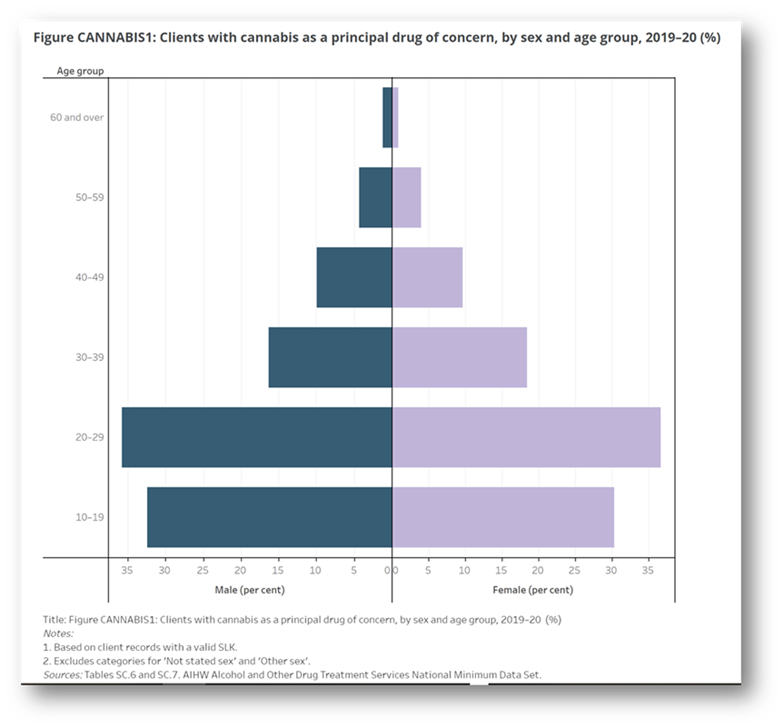
Treatment
Since 2010–11, counselling has remained the most common form of treatment, accounting for around 40% (15,801 episodes in 2019–20) of cannabis treatment episodes annually. In 2019–20, both support and case management (6,599 episodes), and information and education (6,393 episodes) were the second most common main treatment types (both 16%) after counselling
In 2019–20, for treatment episodes where cannabis was the principal drug of concern:
-
- treatment was most likely to take place in a non-residential treatment facility (65%)
- most (80%) episodes where counselling was the main treatment type took place in a
- non–residential treatment facility (Table SD.44)
- almost half (46%) of episodes lasted 2 days to 90 days and 33% ended within 1 day (Table SE.25)
- the median duration of a treatment episode was 22 days
- treatment duration varied by treatment type:
- the median duration for counselling was 8 weeks (57 days)
- support and case management as the main treatment type had a median duration of 6 weeks (43 days)
- rehabilitation lasted nearly 6 weeks (40 days)
- information and education/assessment only had the shortest duration (1 day) (Table SD.47)
- two-thirds (66%) of closed episodes ended with an expected cessation
- where clients were diverted from the criminal justice system, 35% completed treatment due to programs sanctioned by a drug court, and 3 in 10 (31%) treatment episodes ended with an expected treatment completion, with 3% of episodes ending unexpectedly (Table SD.45).
Source of Referral and Diversion Clients
-
- In 2019–20, for treatment episodes where cannabis was the principal drug of concern:
- the most common sources of referral were health service (30%), followed by self/family (28%)
- 1 in 5 (8,497) treatment episodes where cannabis was the principal drug of concern were for clients whose referral was from a police or court diversion (Table SD.37)
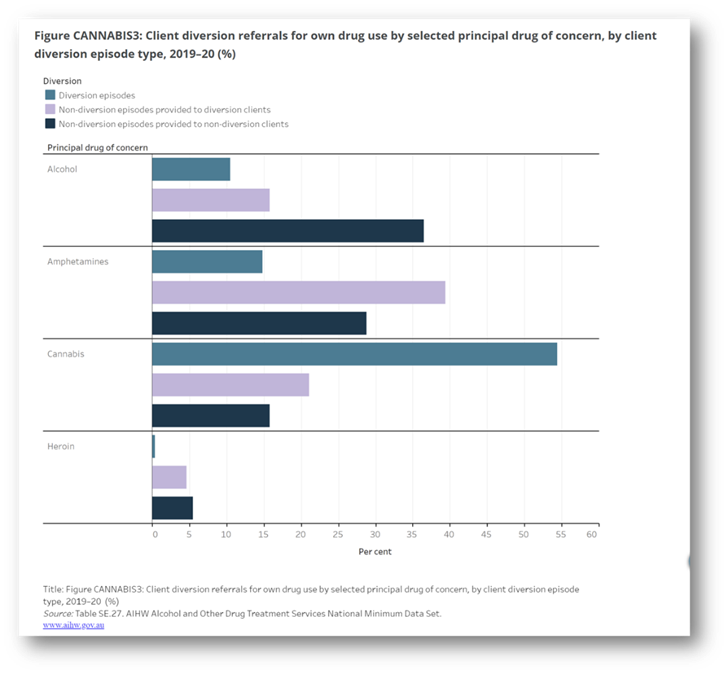
- about 1 in 9 (14,447) of all clients receiving treatment for their own drug use, had a diversion referral and were more likely to be treated for cannabis (54%) as a principal drug of concern; with 21% of diversion clients also receiving non-diversion referrals to treatment for cannabis as a principal drug of concern (Figure CANNABIS3; Table SE.27)
- this was followed by amphetamines (15% referrals from diversion compared with 39% from non-diversion), alcohol (11% diversion compared with 16% non-diversion) and heroin (less than 1% diversion compared with 5% non-diversion) (Figure CANNABIS3; Table SE.27) . AIHW Alcohol and Other Drug Treatment Services Report – Cannabis
Now, rather than go into reams of data in a limited Blog space, we just want to ask some important questions or not only you, the reader, but the Guardians of our community. Questions that require more than a dismissive shrug or ubiquitous Harm Reduction based avoidance meme.
- Why has there been such and increase in the demand for treatment of Cannabis Use Disorder?
- Who ultimately (besides the cannabis using individual) bears the brunt of the financial cost of this ‘recreational’ and illegal activity?
- What are some of the key drivers for this increasing demand, and therefore, use of this drug?
There are other questions, we could pose, but the last one, we will give a part answer to – an answer we encourage you to investigate further.
- Will this concerning culture, economic and health diminishing activity and it’s attending harms increase or decrease with greater permission?
The short answer to that is, undoubtedly – We have seen a gradual but recently accelerating mode of de facto decriminalisation around ‘recreational’ cannabis use; with less and less action by law enforcement on use, the relentless propaganda around ‘medicinal’ pot and the ever-increasing push of pro-drug advocates in the policy space to normalise drug use.
And, of course, the legislative ‘noise’ of tacit promotion that certain parliamentarians make, touting the idea of legalisation. Add to that a heavily manipulated and sycophantic pro-drug social media culture and you have an emboldened drug using demographic gaining ‘social’ clout and driving, if ever so surreptitiously, a faux cultural sentiment of ‘approval’.
We wrote on these Permission Models in our last blog post and we’ll talk more to this in our next one – Looking at the Victorian Parliamentary Inquiry into the Use of Cannabis in Victoria. Until then…
Communications Team @ Dalgarno Institute