
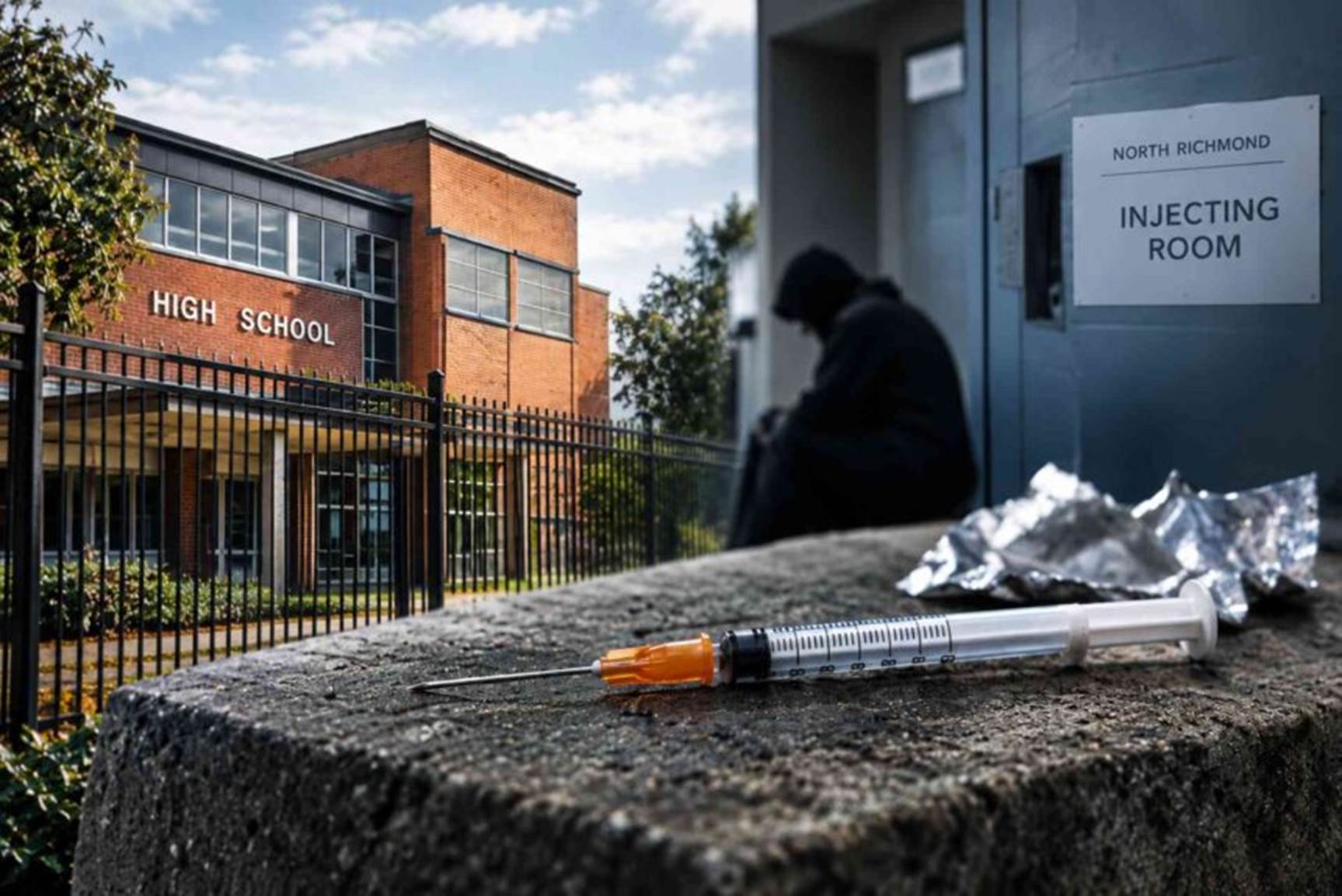
A School, a Knife and a Death Nearby: Putting the North Richmond Injecting Room to the Test
On 18 March 2021, Emma Kealy, the Nationals member for Lowan, put a direct question to Health Minister Martin Foley in the Victorian Parliament. Did he still stand by the decision that an injecting room beside a primary school was safe and appropriate? She asked for a plain yes or no. The Hansard record shows she received neither.
 That exchange is the centre of this piece, but it was not the start of the dispute and it was not the end. What follows runs year by year, and often month by month, from the facility’s opening in 2018 to the weeks before the November 2026 state election.
2018: Warnings before the doors opened
Parents were dismayed before the facility opened in June 2018, EducationHQ reported, because ice use would be allowed within spitting distance of their children. A petition signed by more than 700 people described the site as right next to a school and in the middle of a residential area, according to news.com.au. The Herald Sun reported that police feared the North Richmond supervised injecting facility would draw more dealers to Richmond.
The Government’s reason for the site was the death toll. North Richmond had the highest overdose fatality rate in Victoria in 2016, with one person dying every ten days. The Coroners Court began monitoring heroin-related deaths there in 2012 and held an inquest in 2017, and a trial was recommended. Doctors quoted by newsGP in 2018 warned that closing the room would leave vulnerable people at greater risk of overdose.
2019: Residents, a school and a scandal
October. The Herald Sun reported on 6 October that the state education department had failed to carry out a safety and risk assessment of the facility’s effect on the neighbouring primary school. The source available for this piece is only a short extract, and its exact date is uncertain.
On 25 October, the focus moved to the operator. The ABC and 7NEWS reported that Demos Krouskos, chief executive of North Richmond Community Health, had been stood down after two outreach workers were arrested and charged with drug trafficking. Police said none of the alleged offences happened inside the facility. Acting Mental Health Minister Luke Donnellan said the allegations were extremely serious and ordered an independent review. He also said the trial would run its course, with an independent review due in June 2020.
The same coverage gave both sides of the neighbourhood argument. Resident Dave Horseman said the room had “just concentrated it in the area and made it worse, not better”. Assistant Commissioner Luke Cornelius said drug-trafficking arrests in the Richmond area had risen 152 per cent over twelve months, with 49 arrests since 1 July. Reason Party MP Fiona Patten, who fought for the room, said it was saving lives, though she wanted the services at the health centre reviewed because it had been “inundated”. Monash academic Kate Seear said she was “not sure” the room had brought more drug-related problems, and noted the first-year review recorded 1,200 overdoses. Former premier Jeff Kennett suggested moving it to a commercial area. 7NEWS put the count at more than 1,800 overdoses managed without a death.
Late in the month, MOJO News published its own account (the date on the source is 27 October, though the client’s list says 17 November). It cited Crime Statistics Agency data showing a rise in assaults, robberies, stalking, harassment and threatening behaviour in the block around the facility since it opened. One mother described her three-year-old daughter watching two drug-affected men fight at Victoria and Highett Streets. Councillor Stephen Jolly argued the room should have been put on Victoria Street or further west, in a more industrial area. Councillor Amanda Stone called residents’ concerns “legitimate” but said fear had been allowed to “fester” because the State Government did not act early. She also said Richmond had always had a street drug problem, with people injecting in the primary school playground before the room opened. Monash’s Kate Seear argued that part of the reaction came from the stigma attached to drug use. The council had committed extra money to street clean-ups, and the piece reported more than 10,400 human faeces and 10,000 syringes picked up in North Richmond the previous year. The same piece reported that the facility had managed more than 1,130 overdoses in its first twelve months, made more than 3,300 health and social support interventions, and that CSA data showed an eight per cent drop in drug offences nearby.
2021: The school, the lockdowns and the Hansard answer
March. The week of 15 March was the worst the school community had reported. The Herald Sun ran its coverage around 19 March under the line “Kids caught up in drug drama”. Its exact original date is not confirmed.
On the sitting day, 18 March, Ms Kealy told the chamber that Richmond West Primary School went into lockdown on the Friday while a person in a violent, drug-induced psychosis stood outside it. It locked down again the day before the sitting, she said, when a man armed with a knife entered the grounds. On the morning itself, families were told students must use the rear gate because a dead body lay in front of the school.
Mr Foley did not accept every detail. He said early reports suggested the member might be misinformed on some points, and that the relevant authorities were examining the death. Media coverage supported the core of her account. 3AW reported two lockdowns in one week, a man allegedly wielding a knife on the grounds, a man found dead near the school, and an instruction to avoid the main entrance. The ABC later reported three lockdowns in one week.
Mr Foley’s reply rested on one argument. Services must sit where the harm is, he said, and report after report, including the latest from Professor Margaret Hamilton, backs that view.
The drug market operates in North Richmond, so the room stays for the rest of the five-year trial. He added that Yarra Council, the school community and every independent review support the arrangement.
That is a case about site selection. It explains why a facility might sit in a suburb with a heavy drug market. It does not address what the member asked, which was whether the site is safe and appropriate for primary school children.
The Minister then described a 16-year-old boy with no connection to North Richmond who died of an overdose in a nearby squat during the trial. Every death is a tragedy, he said, and the school community sees the facility as a pathway out. The tragedy is real. Even so, the excerpt does not show that the facility prevented that death or changed its course. A sad example is not evidence of effect.
Ms Kealy’s second question went further. What harm, she asked, is being done to young children who face repeated lockdowns and witness psychotic events? Mr Foley spoke about talks between the school community, the local health centre, Victoria Police and the education department. He did not describe any harm to the children, and he did not say whether anyone measures it. Ms Kealy raised relevance points of order repeatedly, and the Speaker held that the Minister was being relevant. That ruling settled the procedure. It did not settle the policy question.
The ABC reported on 25 March that about 70 people attended a crisis meeting organised by parents the night before. Neil Mallet, whose sons were then 10 and 12, said a man entered the grounds with a knife and that incidents were “snowballing out of control”. He said he had also seen a woman put a needle in her neck at the school gate as children left. A resident named Claire said a man ran through the grounds screaming, and that days later a body was found outside the school. She had called triple-0 the day before about the same man. A parent named Katie, who supported the room, said it should move away from the school.
Acting Premier James Merlino said school feedback was that syringes, paraphernalia and anti-social behaviour had decreased since the opening. He also said the high level of drug activity was the reason the facility was needed. He cited an independent review finding that it had saved at least 21 lives and safely managed more than 3,200 overdoses. Opposition Leader Michael O’Brien said the Government was “putting these kids through hell”. The parent body said it was considering legal action. News.com.au covered the same meeting under the headline “Parents in tears at North Richmond injecting room crisis meeting”.
June. By 30 June, 3AW reported, the Government was spending more than $100,000 on extra safety measures at the school. Parent Neil Mallet called it “just another bandaid over a festering sore”. His reasoning was simple: if the site carried no risk to children, nobody would need new safety measures. Broadcaster Neil Mitchell told listeners the trial had failed, while accepting that a facility like this can save some lives. He argued it was “putting the lives of addicts ahead of the lives of residents and kids”.
2022: Residents say they are being ignored
October. On 6 October, the Herald Sun reported that North Richmond residents had renewed their calls to move the room. They said they had “compassion fatigue” and were fed up with being ignored.
On 31 October, the paper ran a piece on what it called a “major flaw” at the site. Insiders working on Melbourne’s planned next injecting room said they were trying to avoid repeating it. The extract available does not say what the flaw is, so it is not described here.
2023: Permanence
March. Premier Daniel Andrews announced in the first week of March that the facility would be made permanent. On 9 March, news.com.au reported parents’ anger. A former Lennox Street resident, Letitia, described seeing a woman inject into her neck outside the school in August 2019. She said the school had once been welcoming, with a standard fence and a main entrance that was never locked. By 2023 it had two-metre cyclone fencing that stops passers-by looking in. Mr Mallet compared it to a “Supermax prison” and said the children involved in the knife lockdown had needed counselling.
Mr Mallet also said prep enrolments had “completely tanked”. The Education Department did not confirm that, though it noted pupil numbers fell from 324 in 2020 to 296 that year. Education Minister Natalie Hutchins praised the school’s academic record and its Chinese immersion program, and did not say whether she supported the room’s location. A news.com.au reader poll of almost 12,000 found 62 per cent thought the room brought too many drug users to the area, and almost 30 per cent thought it was important but badly placed.
May. On 5 May, news.com.au reported a study from Deakin University and the University of Sydney, led by Jian Liang and Sergey Alexeev, published in Regional Science and Urban Economics. It found homes within 800 metres lost up to $60,000 in value between 2016 and 2021, with larger percentage losses within 400 metres. It found no change for apartments, or for homes between 800 metres and 2 kilometres. The authors ran the same test on the CBD and found no similar effect. The $60,000 figure is a ceiling for one radius and period, not a general estimate. The legislation to make the room permanent passed at about 10pm on a Thursday, backed by the Greens, the Legalise Cannabis Party and the Animal Justice Party.
The Victorian Government also voted that year against a 250 metre ban on injecting facilities near schools, an MP later told Parliament.
2024: A second site is dropped
April. The Government ruled out a second injecting room in the CBD on Tuesday 23 April, with Premier Jacinta Allan and Mental Health Minister Ingrid Stitt announcing the decision. Former police commissioner Ken Lay had recommended it in July 2020 after finding about one drug injector a month was dying in the city. A health hub on Flinders Street replaced it.
On 24 April, Richmond resident Sharon Neven told 7NEWS’s Sunrise she was furious. Every time she left her door she expected an overdose or aggression, she said, and she feared for the children who see it. Her complaint was that the Government had responded to CBD concerns while ignoring Richmond’s. She also said the location had been omitted from the last review report. 7NEWS noted that a review had found the room saved 63 lives.
August. An MP told Parliament that Ontario had announced a 200 metre exclusion zone around schools and childcare centres.
During the year. News.com.au later reported that another overdose death occurred in 2024 on a footpath outside a home near the school gates. A 53-year-old was found under a tarpaulin less than 50 metres from the facility, and students walked past.
2025: The towers, the rallies and the council’s reversal
March. News.com.au published two pieces from the public housing towers at Elizabeth Street. On 24 March, residents described needles in corridors, dealing in the open 30 minutes after school finished and a resident named Jackie who said she had found one body before the room opened “but there have been more after”. Dan, who has lived in the towers since he was 12, called the location “the worst idea ever”. The paper also reported a 32-page parent document describing two lockdowns in a week, children needing counselling and under-10s picking up needles. North Richmond Community Health said almost 8,000 overdoses were managed inside between 2018 and 2023.
On 26 March, the paper published video of a woman injecting a man with what she called “pure heroin” outside the flats. The man struggled and she asked for naloxone. The person who filmed it said children were playing basketball and soccer metres away. The paper cited the Hamilton review’s finding of more than 4,400 overdoses safely managed inside between 2018 and 2021.
April. On 27 April, residents and traders marched through Richmond, and a counter-rally followed in support of the room. The Herald Sun covered it under the headline “‘Injecting room out’: Residents demand action as Richmond drug room threatens public safety”, reporting frustrated residents and traders demanding better safety around the facility, and that not everyone backed the movement. The Greek Herald reported on 29 April that independent candidate Anthony Koutoufides told more than 100 people “Families and children are witnessing flagrant drug use and aggressive behaviour on a daily basis”. Liberal leader Brad Battin and Tim Smith also spoke. The protest followed a Yarra Council survey in which nearly half of residents said they felt unsafe at night. Fiona Patten urged investment in such services at the counter-rally. The Yarra area recorded nearly 12,500 criminal incidents in 2024, the highest since 2015. In the same month, it was announced that North Richmond Health Partners would take over operation of the room.
May. News.com.au later reported footage of schoolchildren walking past a man overdosing less than 50 metres from the school entrance. A boy filmed it and showed his father.
September. The Age reported on 1 September (the client’s list says 6 September) that chief executive Simone Heald had admitted the service initially failed to address community safety concerns. It was her first media interview since taking over two years earlier. A $1.7 million landscaping project was finished and a direct phone line to the school was set up. She said the room had managed more than 10,000 overdoses without a death, and that ambulance attendances within a kilometre had almost halved. She also agreed with a 2023 review finding that constant talk of “saving lives” had alienated residents who felt dismissed.
Mayor Stephen Jolly, then still a supporter, called North Richmond “Disneyland for drug users” and said locals had been “gaslit”. He compared the suburb to a neighbourhood with the city’s only pub. Ha Nguyen, president of the Victoria Street traders association, keeps his cooking school doors locked during classes to stop drug-affected people wandering in. He said the facility does a good job keeping drug use out of the laneways, but traders see it as a drawcard. The state’s Victorian Gambling Regulator had recently left the area, citing staff safety. The room sees about 230 visits a day, and Heald said only a handful of clients were responsible for dumped syringes or menacing behaviour. She said the service could not simply “move people on” without pushing them into places like the public housing towers.
Long-term resident Judy Ryan, a key advocate for opening the room, disputed the idea that North Richmond is “the worst it has ever been”. She said it used to be “code blue all the time” and recalled finding a body in the laneway behind her house. A 32-year-old client, MJ, described using the room after a neuromuscular condition caused severe pain, and said it helped her secure housing, a psychologist and methadone. The Coroners Court had just reported overdose deaths at a 10-year high, with heroin the largest cause. Stitt rejected any second service, fixed or mobile: “we’ve drawn a line under this”. She offered no money towards the roughly $400,000 a year the council spends on syringe clean-up.
November. Yarra Council voted 6-2 on 11 November to withdraw support for the room at its current site, reversing its long-standing backing. Reports appeared on 12 November in The Age and Nine. Mr Jolly called the location “madness” and “the greatest public policy disaster in recent Victorian history”. He said the motion was meant to “poke some people in the eye” in a state election year. Residents told the meeting of frequent drug driving, trade in stolen goods and “multiple sexual exposures to primary school children”. Greens MP Gabrielle de Vietri called it “a thinly veiled push to shut down our overdose prevention centre”. Premier Allan said there was “no intention to change the operations”. The Government said the room had managed more than 11,000 overdoses and saved at least 63 lives. Opposition mental health spokeswoman Emma Kealey said an injecting room next to a primary school was “destined to fail”. It was the same member who had put the question in 2021, now using the shadow portfolio title.
Nine’s report added Mr Jolly’s accusation that the Government had broken a promise. “They said there would be several, so that one suburb, in this instance North Richmond, wouldn’t have to take the heat for the whole of Victoria,” he said. His complaint about services was blunt: “There’s not enough counselling. There’s no rehab, there’s no detox.” Ms Heald called the council’s move a “fundamental misunderstanding” of what the community needs, and said the room “operates where Melbourne’s drug market has existed for decades”. She cited more than half a million visits and more than 11,000 overdoses managed without a death.
The Age added detail on the council meeting. Mr Jolly said the facility should move to Victoria Street or St Vincent’s Hospital, though neither site was in the formal motion. St Vincent’s chief executive Nicole Tweddle pushed back, saying the clients are “some of the most vulnerable people in our community” who might never set foot in a hospital. Greens councillors Sophie Wade and Edward Crossland voted against, saying the change was “sprung on the community” without consultation, and Ms Wade lodged a recision motion. The only Labor councillor, Sarah McKenzie, was absent but said she “would have voted against the change” and supports a medically supervised injecting service. One speaker said police had dubbed the area “a one-stop shop for crime”. Mr Jolly was also facing an unlawful assault charge, and the new motion rewrote a plank of the council’s advocacy plan for the November 2026 state election in the marginal seat of Richmond.
On 16 November, Nine News reported that residents rallied on Victoria Street. Christine Maynard asked for the room to be relocated away from the school and high-density housing: “We are sick to death of watching these drug users rule our world.” Residents challenged Premier Allan to open a room in her own electorate of Bendigo, which they said saw 11 fatal overdoses the year before. A Government spokesperson said it had no plans to move the service. Deputy Mayor Sharon Harrison said the council still supports such rooms, but that “there needs to be more of them so that Richmond is not carrying the weight of the entire load”. Counter-protesters said the facility saves lives. Jill Mellon-Robertson, who lost her 38-year-old son to an overdose ten years earlier, said it is about connecting people to medical and legal support and housing. Karen Hovenga said she no longer picks needles out of her garden.
On 30 November, news.com.au published a seven-year retrospective. Mr Jolly told it car theft in Richmond was 99 per cent above the Victorian average and violent crime 35 per cent above, while still insisting the room “saves heaps of lives”. He said the lack of support services had turned the area into “a dumping ground” and that other suburbs now say “look at what it’s done to North Richmond”.
The paper revisited the August 2019 neck-injection incident Letitia described, and the 2021 lockdowns and crisis meeting. It quoted the parent document in detail. One parent said that after two lockdowns in a week, which involved hiding under a desk, her daughter needed professional counselling and “grips their hands so tightly on the walk it hurts them”. Another said a drug user picked up a syringe and she found two more uncapped needles in the dirt nearby. A third said a drug-affected man passing out on her doorstep locked her family out of their house.
It also reported that a boy filmed a man overdosing less than 50 metres from the school entrance, and that police spent over an hour with the man before moving him “up the hill”. Ms Maynard said of the 2024 death: “It is not the first time and it will not be the last.” The piece repeated Ms de Vietri’s warning that “any deaths that result from shutting down this service will be on the mayor’s hands”, and Premier Allan’s line that the room stays “because it is saving lives”.
2026: Ambulance data, naloxone and the election
June. News.com.au reported on 21 June a woman’s overdose on 11 June, photographed and posted online. The incident was almost two kilometres from the injecting room, so it is not evidence of an effect of the facility. It did prompt a row about whether residents should carry naloxone. The poster wrote “Witnessed by children” in a Facebook group opposed to the room, and the footpath sat next to a public housing block that had recently caught fire, where people appeared to be squatting. Some commenters said the right response was to give naloxone and call an ambulance rather than post a photo. Others said most residents do not carry it and that open-air drug use near schools is already a burden. Victoria’s Chief Addiction Medicine Advisor, Dr Paul MacCartney, encouraged anyone likely to witness an overdose to carry naloxone, and Ms Heald said the operator offers free training. The paper reported more than 650,000 visits and more than 12,500 overdoses safely managed, and noted that Richmond’s record of heroin-related deaths was the highest in Victoria over a nine-year period.
July. On 9 July, the ABC reported a paper in the International Journal of Drug Policy, analysed by Monash University and Turning Point. Heroin-related ambulance call-outs in the Richmond area fell about 71 per cent, from 48 a month in 2018 to 14 in 2023. Central Melbourne fell 43 per cent and the rest of Victoria 36 per cent. Professor Dan Lubman said the area went from more than six times the central Melbourne rate to about three. Mr Jolly said the data showed more rooms were needed, and that the number of people injecting outside the facility was “as big as ever”. Crime remained higher than in 2017 and 2018, though it fell over the last 12 months.
September. On 8 September, news.com.au reported a row over a naloxone vending machine proposed for Victoria Street. The State Government announced in June that it would trial free naloxone machines as part of a $95 million plan to reduce drug-related harms, with North Richmond chosen alongside Brimbank, Sunshine, Darebin, Shepparton, Ballarat and Mildura.
Mr Jolly wrote to Health Minister Ingrid Stitt opposing the Victoria Street site. He said the council “has concerns about the cumulative impact” and that the machine would be “a kick in the teeth” for traders in a street with firebombings and high vacancy rates. He said he supported the machines but wanted them closer to the injecting room and chosen with community input. Ms de Vietri said people would be “at higher risk of dying of an overdose on Victoria Street” and called it “NIMBYism at its most dangerous”. Mr Jolly replied: “Don’t call us NIMBYs, mate.” He noted that Yarra is the only council to host a supervised injecting facility, to call for more of them, and to spend about half a million dollars a year cleaning up needles.
He described three camps among locals. One treats the facility as beyond criticism. Another wants no harm minimisation at all. The majority, he said, sit in the middle: they know someone with an addiction, accept that the room has saved lives, and still say a primary school is not the place for it. “It’s also not ideal to have drug users roam around the streets after they’ve shot up,” he said.
Harm minimisation and normalisation
Supporters of the room say they deserve a fair hearing. Mr Foley and the reviews he cites argue that a facility must sit where people already use drugs. However, isn’t there a critical ‘self-fulling prophecy loop’ in this reasoning? Regardless of that the 2026 ambulance data does give that case real numbers, and whilst a serious critique has to meet them, the ‘meeting’ has reasoning holes in it.
A policy label does not settle the matter, though. “Harm minimisation” is a claim about reducing harm, and a claim needs a full accounting. That accounting has to cover the people who inject at the room. It also has to cover the five to twelve year olds next door, as Mr Mallet pointed out.
The normalisation concern is structural. When lockdown drills, rear gate entry and extra security become routine parts of school life, a community adapts to drug use at its doorstep. Adaptation is not acceptance, but it is how exposure becomes ordinary. A prevention-first approach asks a different question: why does the market sit there, and what would shrink it?
Mr Foley himself spoke of rehabilitation and support as part of the wraparound services. That language deserves follow-through. Mr Jolly’s complaint in 2025 was that there is “no rehab” and “no detox”. The public is entitled to see how many people leave drug use behind, not only how many are supervised while they continue.
Questions the room still has not answered
Who counts the incidents near the school? Does anyone measure what repeated lockdowns do to the children? Why did the Government vote against a 250 metre buffer in 2023 when Ontario set a 200 metre rule? And Yarra Council, which Mr Foley named as a supporter in 2021, now wants the room moved. What does that do to the argument?
A location argument can justify why a service exists in a suburb. It cannot, on its own, justify a service beside a primary school. Until the Government publishes evidence on child exposure, the room will keep drawing the scrutiny it drew on 18 March 2021.
Sources:
- Parliament of Victoria – Richmond medically supervised injecting facility
- Unfriendly Neighbourhood: Residents say safe injecting room has brought crime to their doorsteps
- Safety report failure over injection room impact on primary school
- Boss of Richmond safe injecting room stood down amid drug scandal
- Safe injecting room in spotlight as health centre CEO stood down
- Parents in tears at North Richmond injecting room crisis meeting
- North Richmond injecting room sparks fear among families
- Richmond West Primary School lockdowns linked to safe injecting room prompts crisis meeting of parents
- Outraged North Richmond residents want injecting room moved
- Major flaw with Richmond injecting room revealed
- Disgusted’: Parents unleash after injecting room becomes permanent next door to school
- The effect is large’: Richmond safe injecting room’s $60k cost to devastated homeowners
- Resident reveals reality of living near Richmond injecting room after Victorian government’s decision to scrap CBD site
- Horror inside Melbourne commission towers where residents live next door to heroin ground zero
- Disturbing video shows drug user struggling after ‘pure heroin’ injected outside Richmond flats
- ‘Injecting room out’: Residents demand action as Richmond drug room threatens public safety
- Anthony Koutoufides joins Richmond rally urging relocation of drug injecting room
- Injecting room admits failure to address community concerns
- It’s madness’: Council renews calls to move safe injecting room
- Greatest public policy disaster’: Yarra backflips, wants injecting room moved
- Richmond residents rally against injecting room
- Seven years after North Richmond drug injecting room opened, it remains as divisive as ever
- Debate erupts after woman’s alleged overdose on Melbourne street
- Melbourne injecting room cut ambulance callouts by 70pc …
- Unhinged’: Vending machine debate leads to NIMBY label in Victoria’s heroin epicentre